
Monday Kids Educational DIY Complementary Astable Multivibrator Kit for STEM Learning
$2.50
Availability:
In stock
SKU
diek20250604
Payment Security

We are PayPal Verified
PayPal is a secure and trusted payment processing service that allows you to shop online. PayPal can be used at mondaykids.com to purchase items by Credit Card (Visa, MasterCard, Discover, and American Express), Debit Card , or E-check (i.e. using your regular Bank Account).
DIY Motorcycle 'Doo-Doo-Doo' Sound Circuit Kit
Build your own complementary astable multivibrator circuit for electronics learning
Product Overview
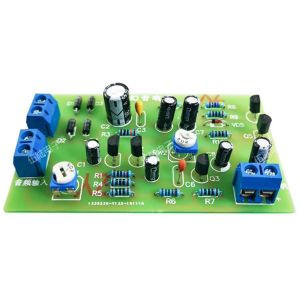
Unleash your inner electronics enthusiast with the DIY Motorcycle 'Doo-Doo-Doo' Sound Circuit Kit! This educational kit allows you to build a complementary astable multivibrator circuit using NPN and PNP transistors to produce a distinctive "doo-doo-doo" sound, mimicking a motorcycle engine.
Perfect for students, hobbyists, and educators, this kit is designed for circuit labs, STEM classrooms, or home experimentation. By assembling this circuit, you'll explore analog electronics concepts, including transistor biasing, RC timing networks, and self-oscillating circuits.
This hands-on kit is ideal for beginners and intermediate learners, offering a practical way to understand how complementary transistors and capacitors work together to generate oscillations. Experiment with different component values to observe changes in frequency and sound, deepening your understanding of analog circuit design.
Learning Objectives
Multivibrator Fundamentals
Understand how NPN and PNP transistors form a self-oscillating circuit without external triggering, producing a continuous square wave with harmonic components.
RC Timing Networks
Experiment with capacitors and resistors to control oscillation frequency and observe their impact on the circuit's output.
Component Functionality
Gain hands-on experience with transistors, capacitors, resistors, and speakers, including proper handling of polarized electrolytic capacitors.
Circuit Analysis
Use a multimeter and oscilloscope to measure voltages and waveforms, discovering non-ideal effects like leakage currents and parasitic capacitance.
Practical Skills
Build, test, and modify circuits on a breadboard, fostering problem-solving and critical thinking in electronics.
Kit Contents
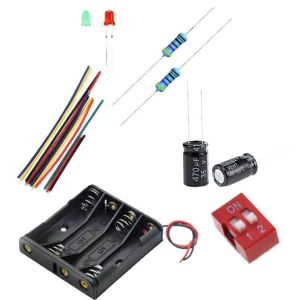
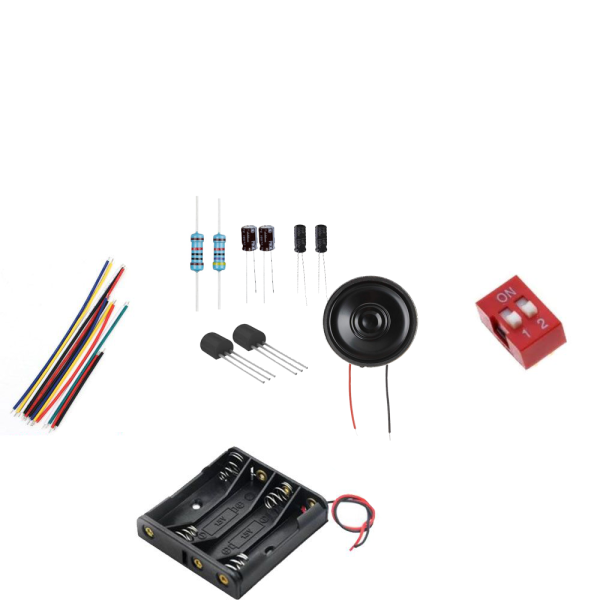
- 1 x 10kΩ Resistor
- 1 x 47kΩ Resistor
- 2 x 47µF Electrolytic Capacitors (C1, C3)
- 2 x 1µF Electrolytic Capacitors (C2, C4)
- 1 x S9013 NPN Transistor (Q1)
- 1 x S9012 PNP Transistor (Q2)
- 1 x 8Ω 0.5W Speaker
- 1 x 3V DC Power Source (2–3V)
- 1 x 2-Bit Slide Switch (S1)
- Breadboard and jumper wires
- Instruction manual with circuit schematic
Step-by-Step Instructions
1
Build the Circuit
Refer to the circuit schematic and breadboard layout to assemble the complementary astable multivibrator circuit.
Caution: Ensure correct polarity for electrolytic capacitors C1 and C3 to prevent damage.
Circuit Schematic:
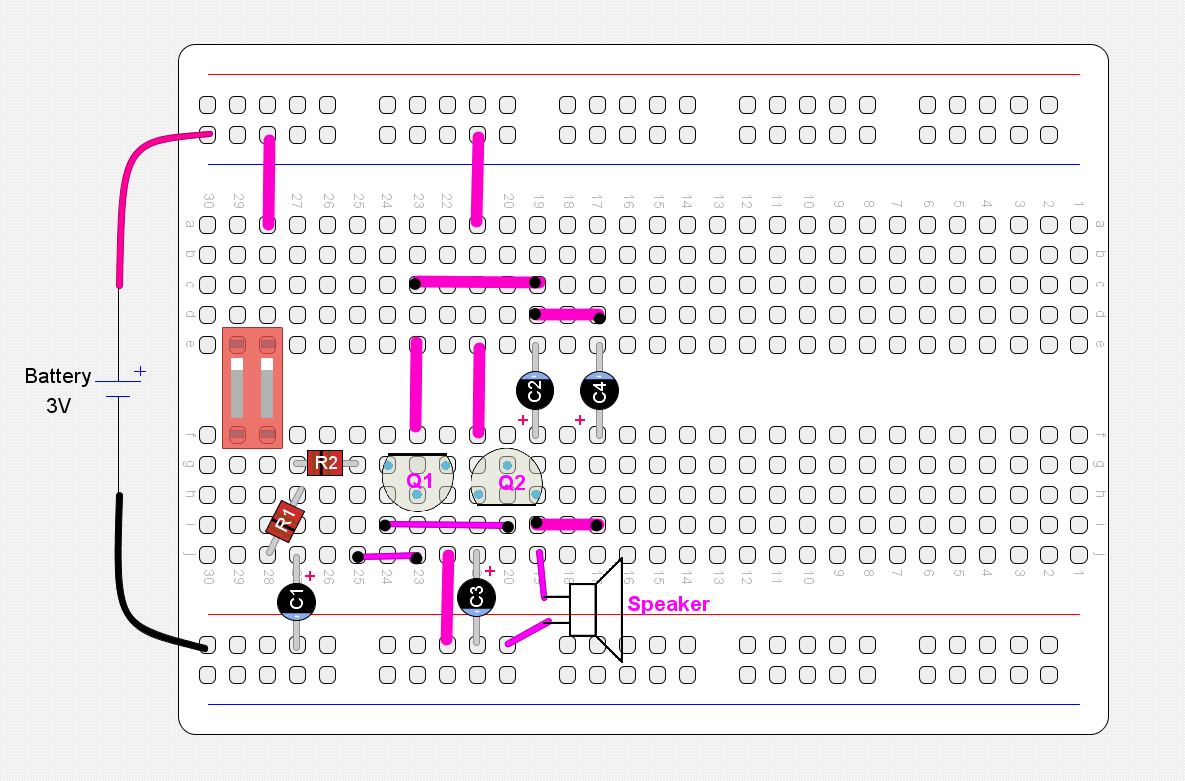
Breadboard Layout Notes:
- Place S9013 NPN (Q1) and S9012 PNP (Q2) with flat sides facing same direction
- Connect speaker between Q2's collector and ground
- Ensure switch (S1) is in series with 2 to 3V power source
2
Power On and Observe
Close switch S1 to power the circuit. The speaker will emit a "doo-doo-doo" sound characteristic of a motorcycle engine.
Experiment: Replace C2 and C4 with larger capacitors (e.g., 10µF). The oscillation period increases (T = 2πRC), resulting in longer intervals between sounds.
3
Measure Voltages
With the switch off, use a multimeter to measure the voltage across the speaker. You'll read approximately 0V, as the speaker acts like a short circuit in DC conditions.
4
Experimental Extension – Short-Circuit the Speaker
Replace the speaker with a wire, connecting Q2's collector directly to ground. Power on the circuit and use an oscilloscope to measure the waveform at Q2's collector.
5
Experimental Extension – Modify the Circuit
Modify the circuit by adding a 10nF ceramic capacitor (C4) in parallel with C3. Power on the circuit - the speaker now produces a continuous tone resembling a CNC machine.
Further Experiment: Remove the 10nF capacitor and revert to the original circuit. Observe how environmental factors influence circuit behavior.
Educational Value
- Transistor Operation: Understand how NPN and PNP transistors work in complementary configuration
- RC Timing: Explore how capacitor and resistor values determine oscillation frequency
- Non-Ideal Effects: Discover real-world phenomena like leakage currents and parasitic capacitance
- Waveform Analysis: Visualize voltage spikes, charging curves, and frequency changes
- Component Interplay: Learn how inductive loads and capacitive elements interact
Why Choose This Kit?
Beginner-Friendly
No prior electronics experience required, with clear instructions and simple breadboard setup.
Hands-On Learning
Build, test, and modify the circuit to see real-time results.
Versatile Applications
Ideal for circuit labs, STEM education, or hobbyist projects.
Experimentation
Adjust component values to explore frequency changes and waveform effects.
Safe & Accessible
Operates on low-voltage 3V supply, perfect for classroom or home use.
Specifications
Power Supply
2–3V DC
e.g. 2 AA batteries
Output Sound
"Doo-Doo-Doo"
Motorcycle-like sound
Frequency Range
100Hz-2.3kHz
Adjustable via components
Assembly Time
~5 min
Beginner friendly
Skill Level
Beginner
to Intermediate
Safety Notes: Ensure correct polarity for capacitors • Use only 2-3V power source • Handle transistors carefully to avoid static discharge
Write Your Own Review
Discover More Products from Its Parent Categories: