
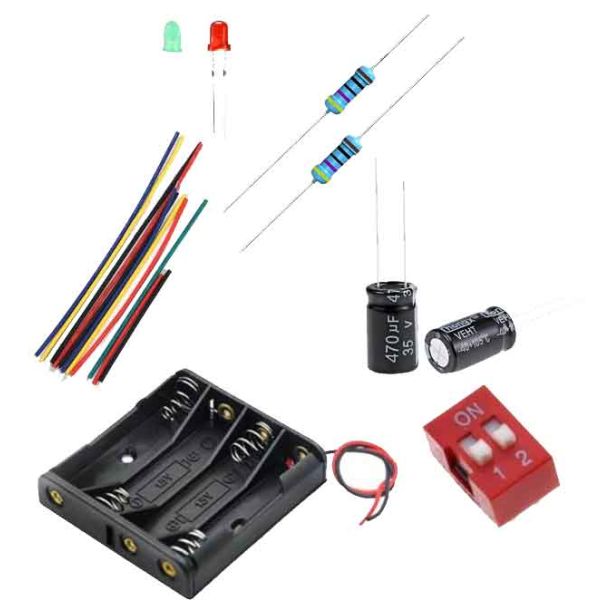

Monday Kids Capacitor Charging and Discharging Experiment Study kits
$0.50
Availability:
In stock
SKU
DIEK20240612
Payment Security

We are PayPal Verified
PayPal is a secure and trusted payment processing service that allows you to shop online. PayPal can be used at mondaykids.com to purchase items by Credit Card (Visa, MasterCard, Discover, and American Express), Debit Card , or E-check (i.e. using your regular Bank Account).
Brand Name: Monday Kids
is_customized: Yes
Model Number: BOMB-20240612A
Working Voltage: 6V DC
RC constant: 441ms
This is a circuit that allows you to intuitively understand the charging and discharging process of a capacitor, helping you to better comprehend how a capacitor works. This circuit demonstrates two prominent characteristics of a capacitor:
Characteristic One: capacitor has the ability to prevent sudden changes in voltage across its two terminals.
Characteristic Two: capacitor has the ability to store energy.
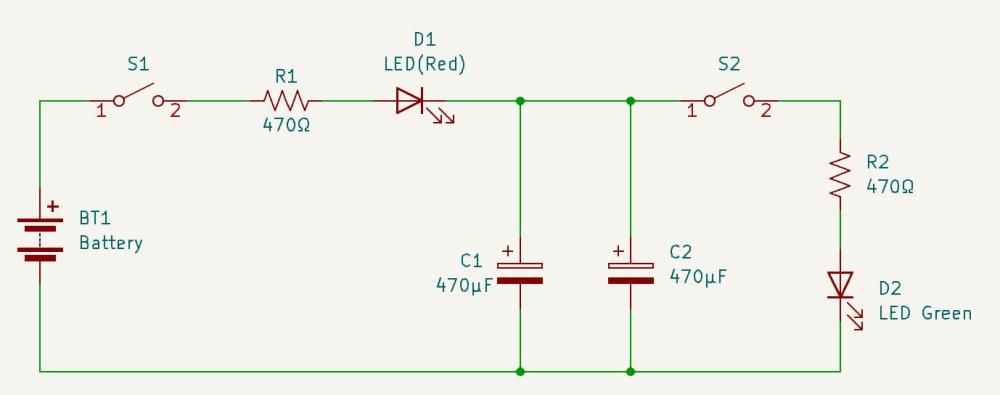
Steps to verify the characteristic one:
1. First, keep S1 and S2 in the open state.
2. Connect the power supply. If you have an oscilloscope, touch the probe of the oscilloscope to the two ends of the capacitor C1. If you don’t have an oscilloscope, you can fix the probe of the voltmeter at the two ends of C1.
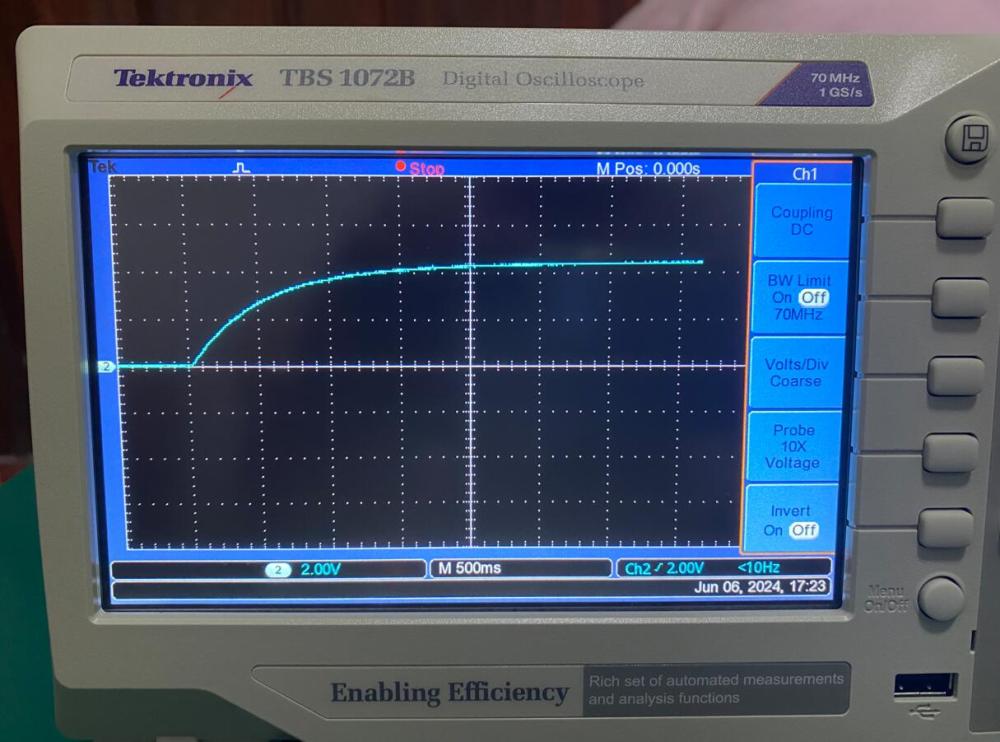
3. Close S1. You will find that the red LED D1 gradually dims from the brightest. This is because the brightness of the LED is determined by the voltage difference between the positive pole of the power supply and the positive pole of the capacitor. At the very beginning, the voltage at the positive pole of the capacitor is at its lowest state, and the voltage difference between the positive pole of the power supply and the positive pole of the capacitor is at its maximum state. As the voltage at the positive pole of the capacitor gradually increases, the voltage difference across the red LED gradually decreases, so the red LED gradually dims from the brightest. At the same time, you can see on the oscilloscope that the charging curve of the capacitor is a curve that gradually increases but the curvature constantly decreases, or you can see on the voltmeter that the voltage value at both ends of the capacitor gradually increases, and the increase becomes smaller as it goes later. Conclusion: From the moment the power supply is turned on, the voltage across the capacitor cannot directly jump to the maximum value, which shows that the capacitor has the characteristic of preventing sudden changes in voltage at both ends.
The following graph shows the actual measured charging curve of the capacitor, which demonstrates the trajectory of the voltage changes across the capacitor over time:
Steps to verify the characteristic two, based on the steps of verifying the characteristic one:
1. Disconnect S1. At this point, the power supply is cut off from continuing to supply power to the capacitor.
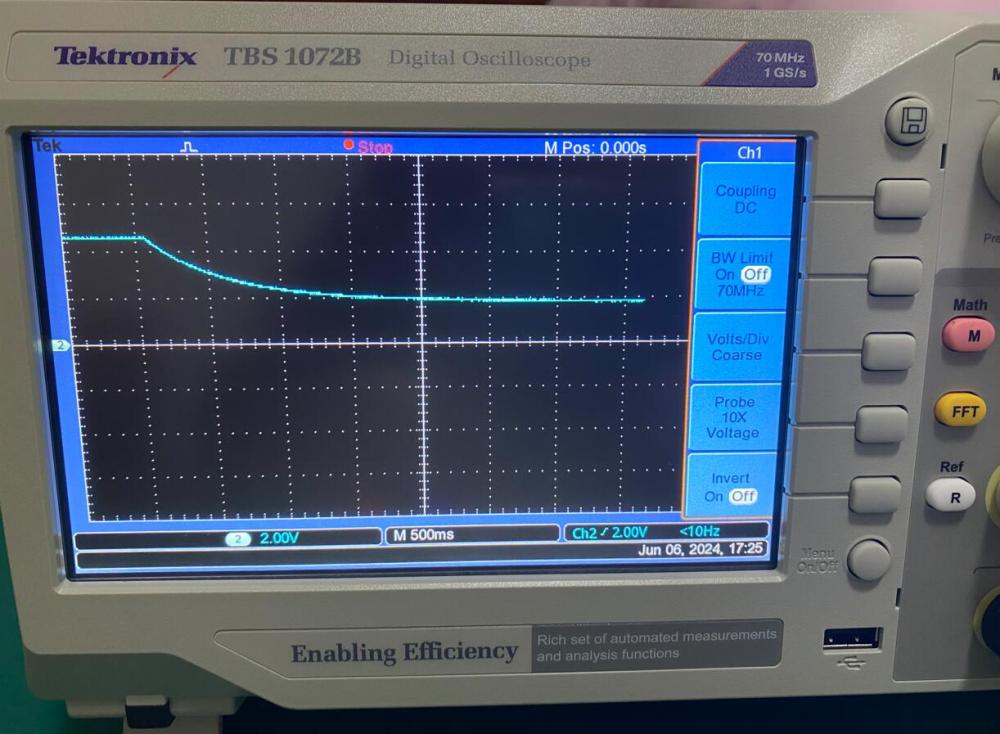
2. Close S2. You will see the green LED light up, and at the moment S2 is closed, the green LED reaches its brightest state, and then gradually goes out. This is because the capacitor has stored energy that flowed from the power supply before this. Even after the connection to the power supply is cut off, closing S2 allows current to flow from the positive pole of the capacitor through the green LED to the negative pole of the capacitor, so the green LED lights up. The green LED then gradually goes out because the charge of the capacitor is being discharged. In this circuit, since the forward voltage of the green LED is around 2 to 3V, after the LED light is completely out, there is still about 2V voltage remaining at the pins of the capacitor.
The following graph shows the actual measured discharge curve of the capacitor, which demonstrates the trajectory of the voltage changes across the capacitor over time:
Additionally,You can use these to create a reference data set by increasing or decreasing the capacitor's capacity. This will allow you to compare the charging and discharging times of the capacitor with respect to the capacitor's capacity and the resistor's value. If you don't have an oscilloscope, you can observe the changes in the LED's brightness over time to understand how varying the capacitor's capacity affects the charging and discharging times.
Package Including:
5 x 830 Points MB-102 Breadboard
5 x Red LED
5 x Green LED
10 x 470uF Capacitors
10 x 470Ω Resistors
5 x 2-Bit Slide Type Switch
50 x Jumper Wires (Random Colors Random Lengths)
5 x 4-slots AAA Battery Holder
5 sets of capacitor charging and discharging experiment kits (Due to airline restrictions, batteries are not allowed to be transported in parcels by air. Therefore, you will need to provide your own AAA batteries)
To see the running effect, please click here to watch the video
Write Your Own Review
Discover More Products from Its Parent Categories:


